

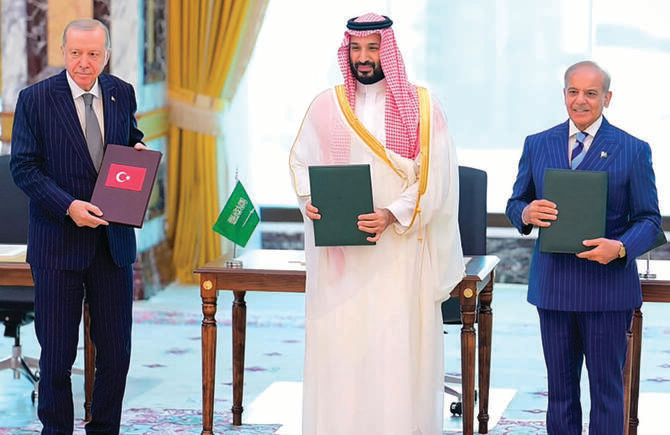

When Saudi Arabia, Pakistan and Turkiye signed the Makkah Joint Defense Agreement on Aug. 7, they went significantly further than pledging closer military cooperation.
The agreement contains a collective-defense commitment: An external armed attack against any one of the three states will be regarded as an attack against them all.
That provision immediately elevated the pact from another defense partnership to a potentially significant new component of the Middle East’s evolving security architecture.

Turkish Foreign Minister Hakan Fidan subsequently compared the principle behind the agreement to NATO’s Article 5.
The three states would decide through consultations what form and degree of assistance was required, while a ministerial committee and a permanent secretariat based in Saudi Arabia are expected to develop the alliance’s institutional and operational framework.
The Makkah agreement is not meant to be NATO in miniature. It has no publicly disclosed integrated military command, permanently assigned forces or detailed mechanism stipulating how members must respond to an attack.
But its significance lies in the fact that three of the Muslim world’s most consequential military and political powers have formally tied their security interests together at a moment of exceptional regional instability.
Saudi Arabia brings enormous economic and diplomatic weight and a rapidly expanding defense sector. Turkiye brings NATO’s second-largest military, extensive combat experience and one of the world’s fastest-growing defense industries. Pakistan contributes a large, experienced armed force and an established decades-long military relationship with the Saudi Arabia.

Together, the three offer a combination of financial resources, manpower, military technology and strategic geography that few regional coalitions could replicate.
And perhaps, most importantly, the pact points to a broader change in thinking: Middle Eastern states increasingly seeking security arrangements in which regional powers themselves assume a greater share of the burden.
Saudi Arabia and Pakistan had already signed a Strategic Mutual Defense Agreement in September 2025, pledging that an attack against either country would be considered an attack against both.
The new agreement expands that mutual defense framework to Turkiye, a NATO member with one of the region’s largest militaries.

The Makkah agreement adds a new layer of deterrence to Saudi Arabia’s existing security relationships rather than replacing them.
That distinction also applies to Washington.
For decades, the US has been the principal external security partner of the Gulf states. None of the three signatories has indicated that the new pact is intended to replace American partnerships, and Turkiye remains a NATO member.
Instead, the agreement can be understood as strategic redundancy; maintaining existing alliances while building additional mechanisms that reduce reliance on any single security guarantor.
Questions about the reliability and limits of US protection have periodically intensified in Gulf capitals, particularly after attacks on Saudi oil facilities in 2019 and Israeli strikes on Doha in Qatar in 2025. Those episodes helped to accelerate interest in alternative and complementary security arrangements.
The suggestion that the security agreement’s timing is a direct result of Iranian attacks on its neighbors has been rejected by all three signatories.

Fidan has insisted that Iran — or any other country — is not identified as an adversary, saying the pact applies only when a member comes under attack. Saudi officials have similarly rejected suggestions that the agreement establishes a sectarian military bloc.
Pakistan has simultaneously maintained relations with Tehran and played a mediating role during the Iran conflict, while Turkiye shares a long border and extensive economic and diplomatic ties with Iran.
For Saudi Arabia, meanwhile, deterrence does not mean confrontation. The pact’s longer-term importance may ultimately be found not on the battlefield but in factories, shipyards and research centers.
Saudi Arabia and Turkiye have already developed significant defense-industrial ties.
These can be seen in Saudi agreements with Turkish drone manufacturer Baykar involving technology transfer and joint production, and Saudi Arabian Military Industries agreements with Turkish companies aimed at localizing defense manufacturing.
Pakistan and Turkiye, meanwhile, have a history of cooperation in shipbuilding, training and other defense programs.
Bringing those relationships under a trilateral strategic framework creates opportunities.
Saudi capital and localization ambitions could be combined with Turkish drone, electronics and naval expertise and Pakistani aerospace, missile and defense-production capabilities.
For the Kingdom, such cooperation dovetails with the wider objective of building domestic military industries rather than relying almost entirely on imported equipment.
For Turkiye and Pakistan, Saudi investment could help to finance new programs while providing access to one of the world’s largest defense markets.
The result could eventually be a defense-industrial triangle capable of jointly producing equipment designed specifically for regional threats — particularly drones, missiles, air-defense systems, electronic warfare platforms and naval capabilities.
For decades, Middle Eastern security has largely been shaped by external powers, bilateral relationships and temporary coalitions assembled in response to individual crises.
The Makkah agreement suggests a different model may be emerging.
Saudi Arabia, Pakistan and Turkiye appear to be constructing an additional layer of collective deterrence centered on powerful regional states themselves.
Regular military exercises, intelligence sharing, integrated air and missile defense, maritime cooperation, joint defense production and clear procedures for responding to attacks would gradually turn political symbolism into genuine military capability.
Saudi Arabia, Pakistan and Turkiye have publicly declared that their individual security can no longer be considered entirely separate.
In a region where conflicts increasingly cross borders, missiles and drones travel hundreds of kilometers, and attacks on shipping or energy infrastructure can send shocks through the global economy, that principle alone marks an important change.
The Makkah Joint Defense Agreement may not yet be a Middle Eastern NATO.
But it could be the clearest indication yet that some of the region’s most powerful states no longer intend to wait for outsiders to design their security architecture for them.

